Navigating the website#
The mOTUs database website contains overview tables for all mOTUs, genomes, samples, and studies that are part of the database, as well as an overview of biosynthetic gene clusters (BGCs) detected after running antiSMASH v6.1 on all genomes. For each mOTU, genome, sample, and study, an individual page containing more information is available.
For each overview table, a search box with autocomplete suggestions is available in the upper right corner - this search is flexible and will match partial or approximate terms. Global search across all tables can be executed from the landing page.
NOTE: Column-specific search requires an exact match and will not return results for partial terms. Use the search box for partial or approximate searches.
NOTE: All taxonomic annotations are derived from GTDB R226. Please use provided taxonomy maps for NCBI and other versions of GTDB if you don’t find your taxon of interest.
mOTUs#
mOTU overview table#
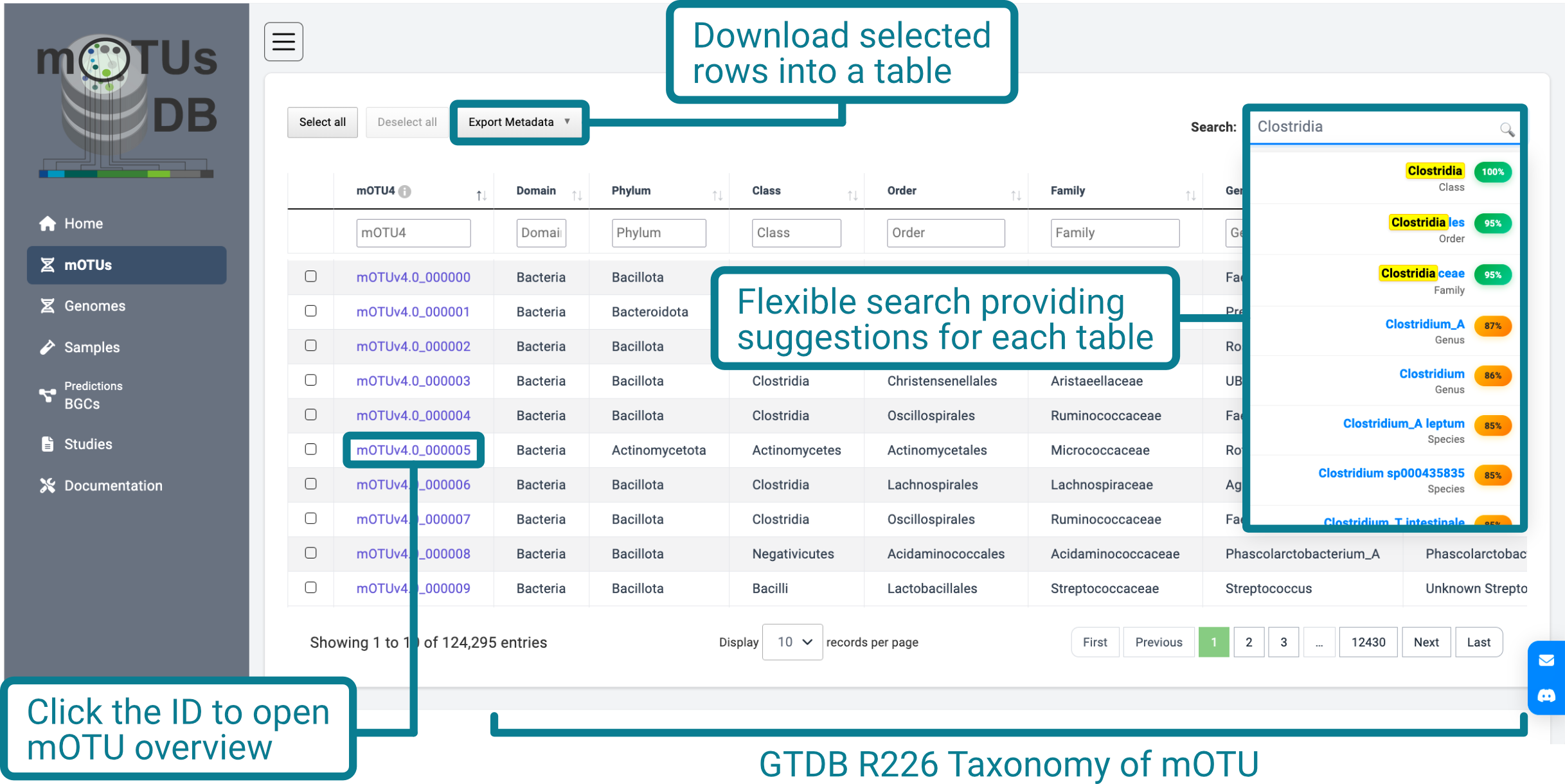
The following table provides a description of each column in the mOTU collection overview.
Field Name |
Description |
|---|---|
mOTU4 |
Unique mOTU species cluster identifier (compatible with versions 4.0 and 4.1). |
Domain |
GTDB R226 domain annotation (majority vote). |
Phylum |
GTDB R226 phylum annotation (majority vote). Displays |
Class |
GTDB R226 class annotation (majority vote). Displays |
Order |
GTDB R226 order annotation (majority vote). Displays |
Family |
GTDB R226 family annotation (majority vote). Displays |
Genus |
GTDB R226 genus annotation (majority vote). Displays |
Species |
GTDB R226 species annotation based on majority vote. Displays |
MicrobeAtlas |
External link to the corresponding MicrobeAtlas OTU when available. Displays |
Representative |
Identifier for the representative genome for this mOTU. Links to the corresponding genome page. |
Genomes#
Genome overview table#
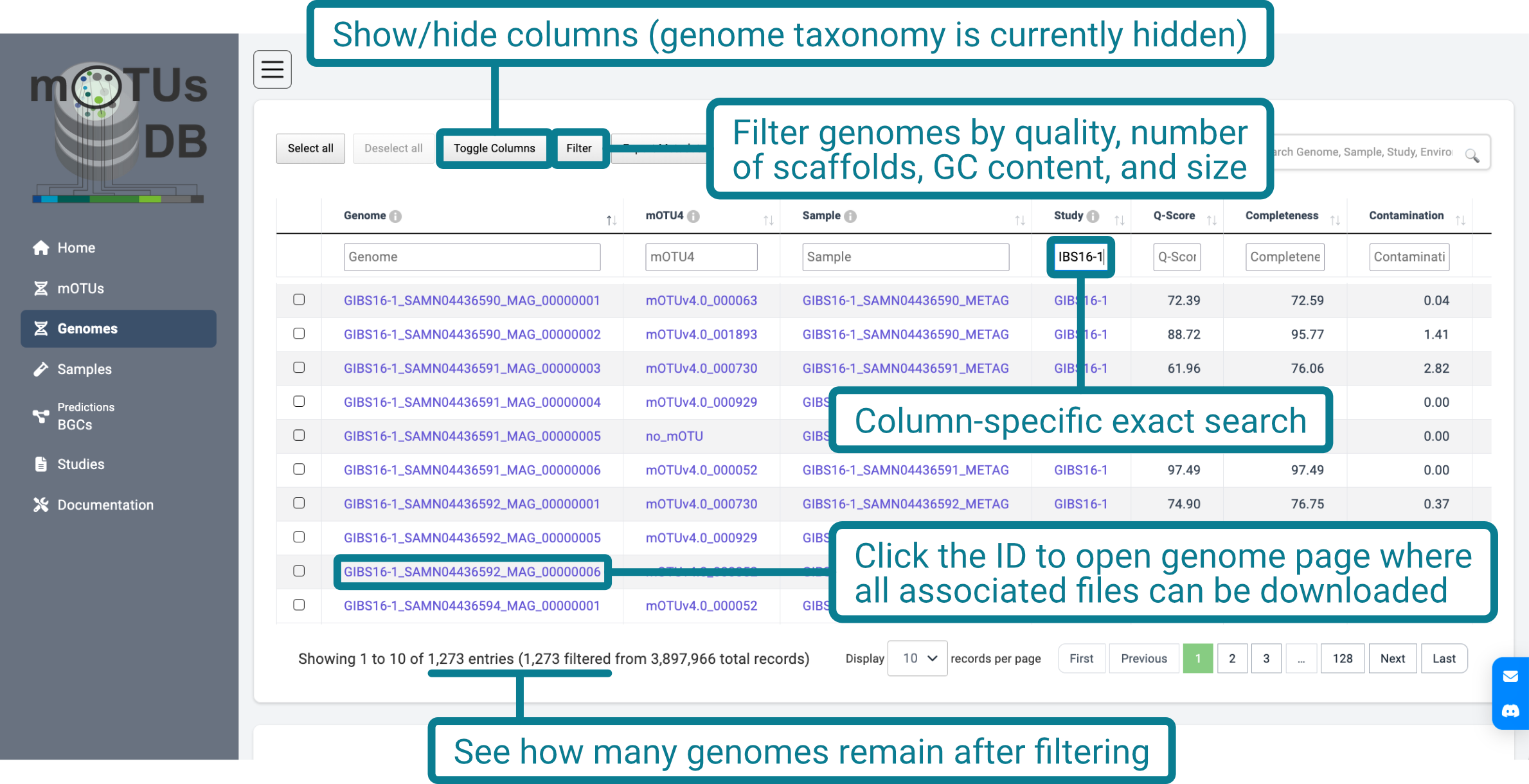
The following table provides a description of each column in the genome collection overview.
Field Name |
Description |
|---|---|
Genome |
Genome identifier representing a metagenome-assembled genome (MAG), single-cell assembled genome (SAG) or isolate. |
Domain |
GTDB R226 domain annotation from GTDB-Tk. |
Phylum |
GTDB R226 phylum annotation from GTDB-Tk. |
Class |
GTDB R226 class annotation from GTDB-Tk. |
Order |
GTDB R226 order annotation from GTDB-Tk. |
Family |
GTDB R226 family annotation from GTDB-Tk. |
Genus |
GTDB R226 genus annotation from GTDB-Tk. |
Species |
GTDB R226 species annotation of the genome from GTDB-Tk. |
mOTU4 |
Unique mOTU species cluster identifier (compatible with versions 4.0 and 4.1). |
Sample |
Unique internal sample identifier, related to genome origin: the metagenomic sample for MAGs, or the source sample for isolates and SAGs. |
Study |
Unique internal study or project identifier, generally associated with a single publication or expedition. |
Q-Score |
Integrated quality metric calculated as: \(Completeness - (5 \times Contamination)\). |
Completeness |
Estimated genome completeness percentage (0–100). |
Contamination |
Estimated genomic contamination percentage (0–100). |
N50 |
Assembly quality metric; 50% of the genome is contained in scaffolds of this size or larger. |
#Scaffolds |
The total number of scaffolds in the genome assembly. |
MAG |
Indicates whether the genome is a metagenome-assembled genome (MAG). |
Is Rep |
Indicates whether the genome is the representative genome of its mOTU cluster. |
Representative |
Identifier of the representative genome for the associated mOTU cluster. |
Filtering genomes#
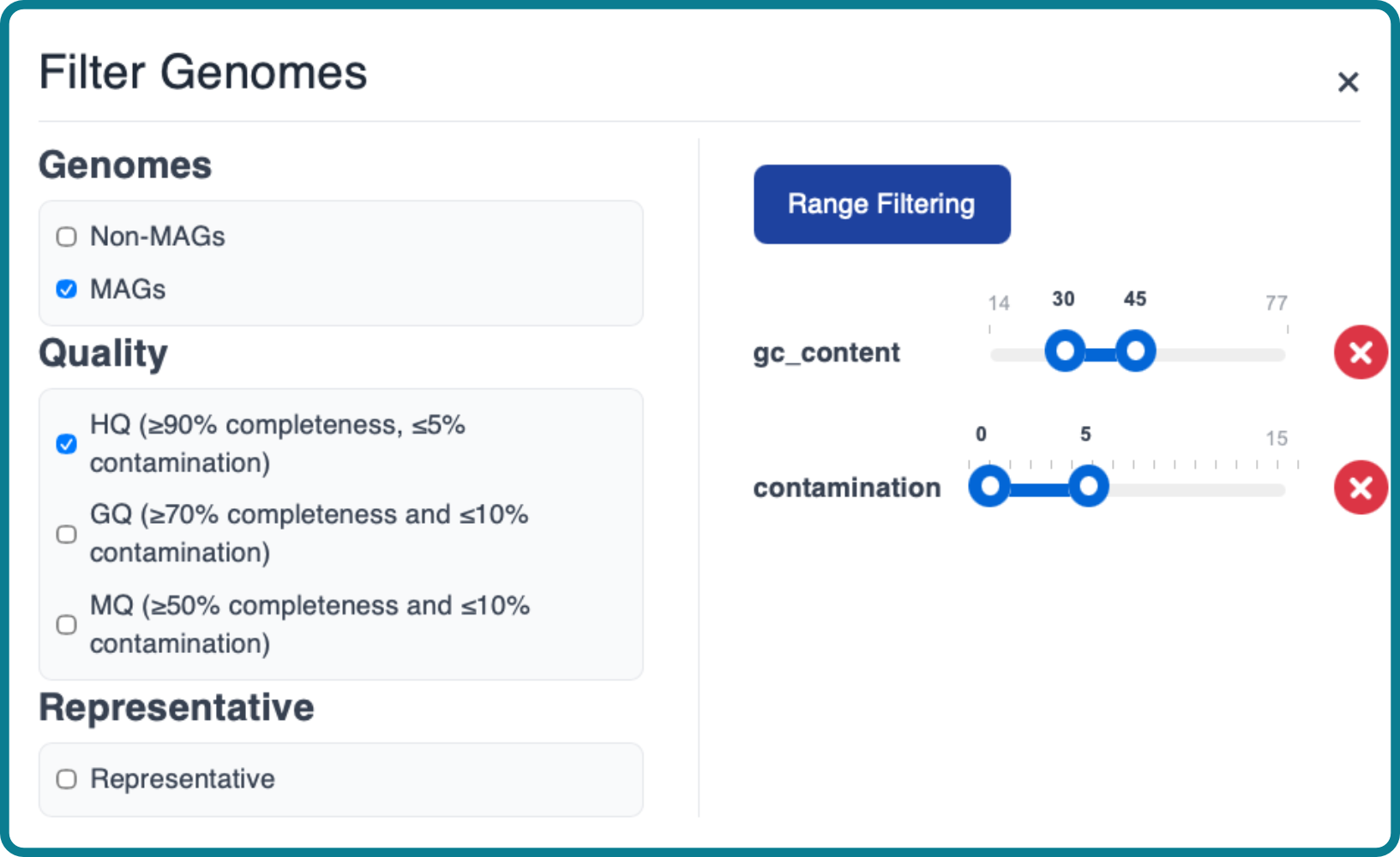
Clicking the Filter button on the genome collection overview page will open a Filter Genomes panel, which allows users to narrow down the genome collection based on several criteria.
Users can select whether they are interested in Non-MAGs or MAGs; high-quality, good-quality, or medium-quality genomes; or representative genomes only.
On the right half of the panel, range filtering sliders enable users to set minimum and maximum thresholds for continuous variables such as assembly and genome quality metrics, GC content, and genome size. Once filtering is complete, the panel can be closed to explore the selection. A loading bar will appear at the top of the panel if filtering takes longer than expected.
Samples#
Sample overview table#
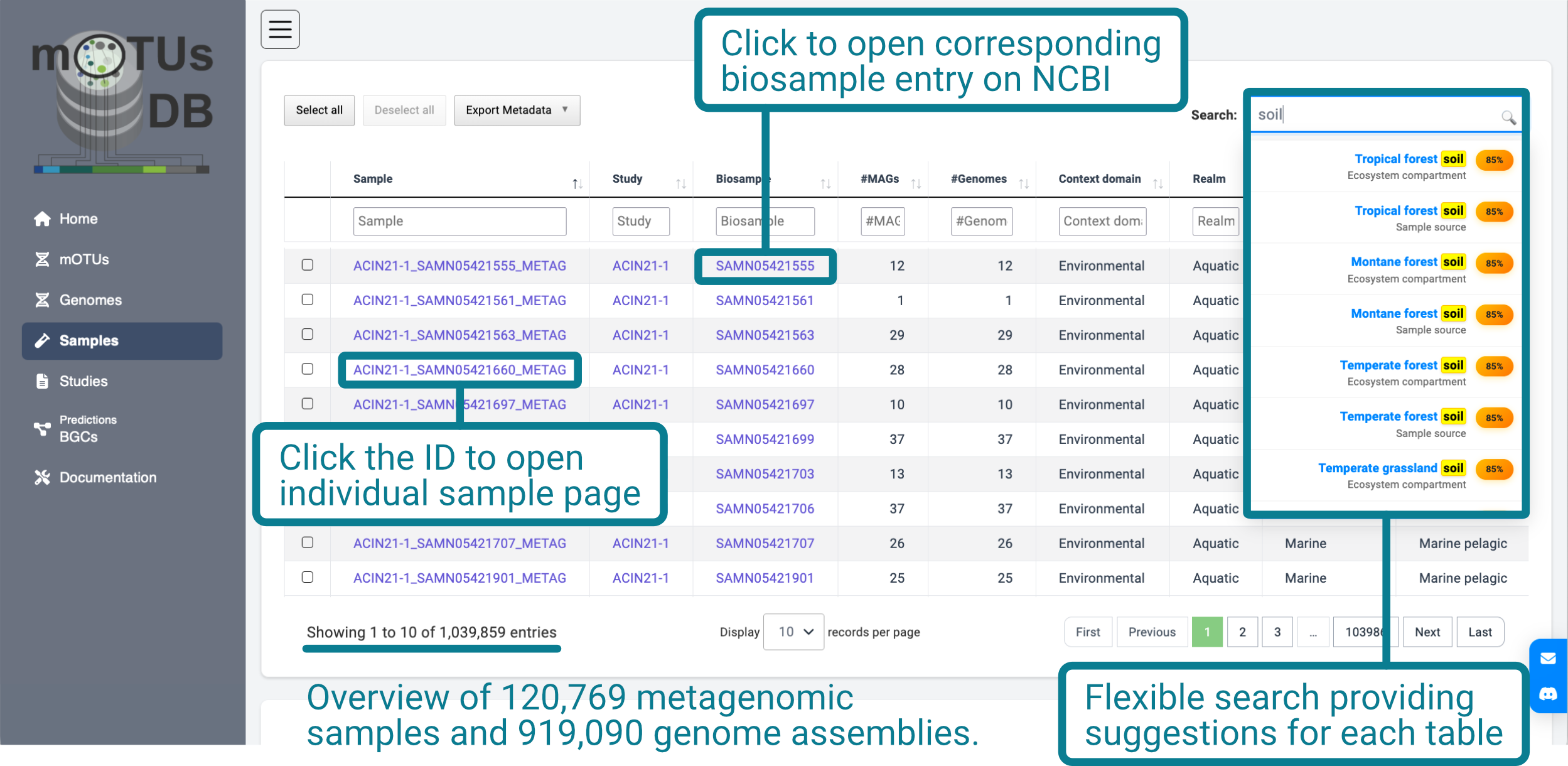
The following table provides a description of each column in the sample collection overview. For environmental annotations, you can find an overview of all available terms here and the distribution of samples annotated to different environments here.
Field Name |
Description |
|---|---|
Sample |
Unique internal sample identifier. For MAGs, includes the metagenomic sample of origin; for Isolates and SAGs, includes the NCBI/JGI genome assembly identifier. |
Study |
Unique internal study or project identifier, generally associated with a single publication or expedition. |
Biosample |
External link to the NCBI/JGI identifier. For metagenomic samples, links to the BioSample record; for Isolates and SAGs, links to the RefSeq/GenBank identifier. |
#MAGs |
Number of genomes reconstructed from a metagenomic sample. For Isolate/SAG source samples displays “0”. |
#Genomes |
Number of genomes (MAGs, SAGs, and Isolates) associated with this sample. |
Context Domain |
High-level environmental classification: Host-associated, Anthropogenic, or Environmental. |
Realm |
Major ecological division, e.g. Animalia-associated, Built Environment, Aquatic. |
Ecosystem Type |
Environmental category, e.g., Mammalia, Urban, Marine. |
Ecosystem |
Detailed environmental system description, e.g. Human gut system, Wastewater system, Marine pelagic. |
Ecosystem Compartment |
The specific environmental niche or physical fraction sampled, e.g. Human stool, Wastewater plant, Seawater. |
Sample Source |
The physical material (and host if applicable) from which the DNA was extracted, e.g. Human stool, Wastewater plant sludge, Seawater. |
Studies#
Study overview table#
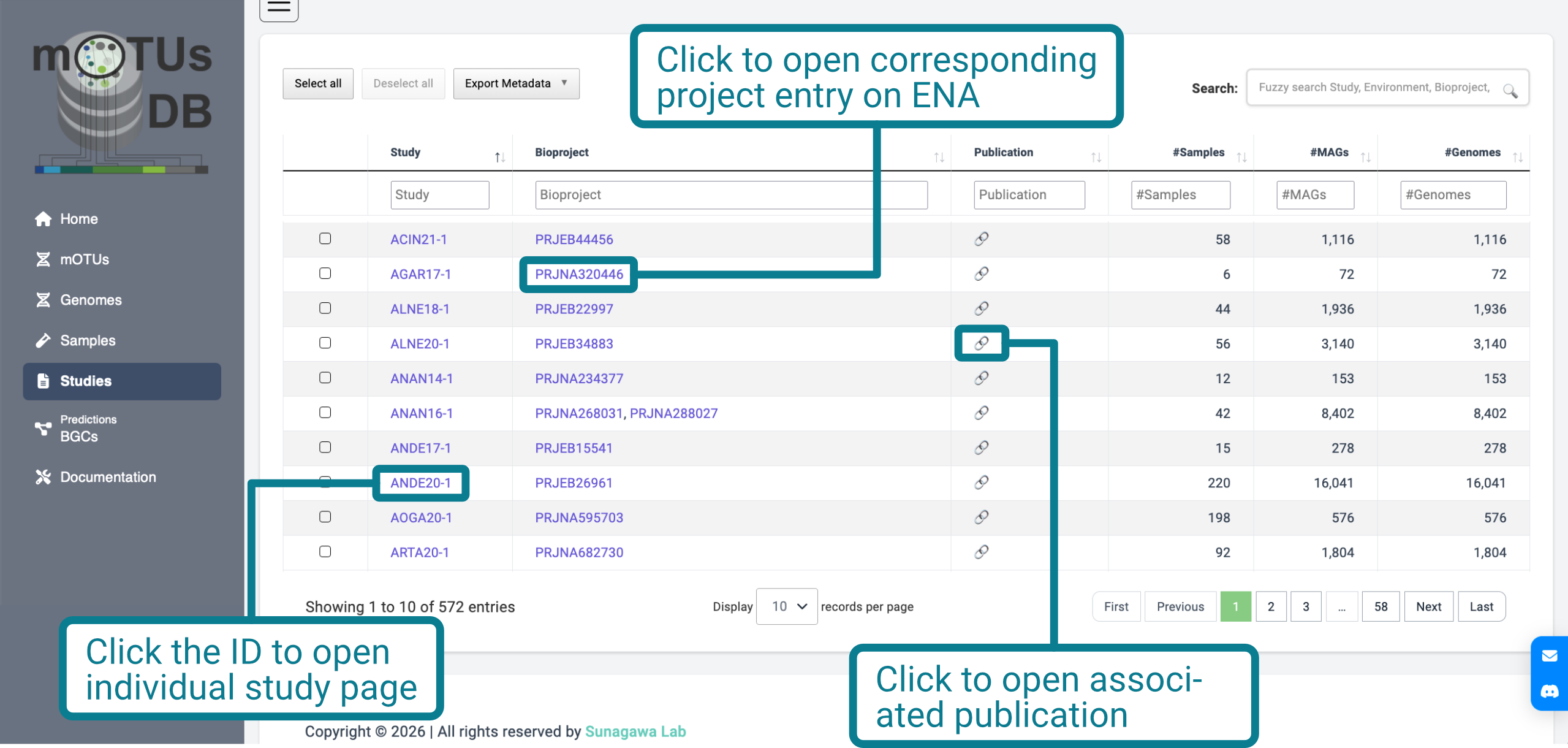
The following table provides a description of each column in the study collection overview. Note that study identifiers RSGB23-1 and RSGB23-2 refer to genomes downloaded from NCBI
RefSeq/GenBank and study identifier JGIG23-1 refers to genomes downloaded from JGI.
Field Name |
Description |
|---|---|
Study |
Unique internal study or project identifier, generally associated with a single publication or expedition. |
Bioproject |
External link to the ENA project page if available. Displays “Unknown_bioproject” otherwise. |
Publication |
External link to the peer-reviewed article associated with this study. |
#Samples |
Number of metagenomic or source samples associated with this study. |
#MAGs |
Number of MAGs associated with this study. |
#Genomes |
Number of genomes (including MAGs, isolates, and SAGs) associated with this study. |
BGCs#
BGC overview table#
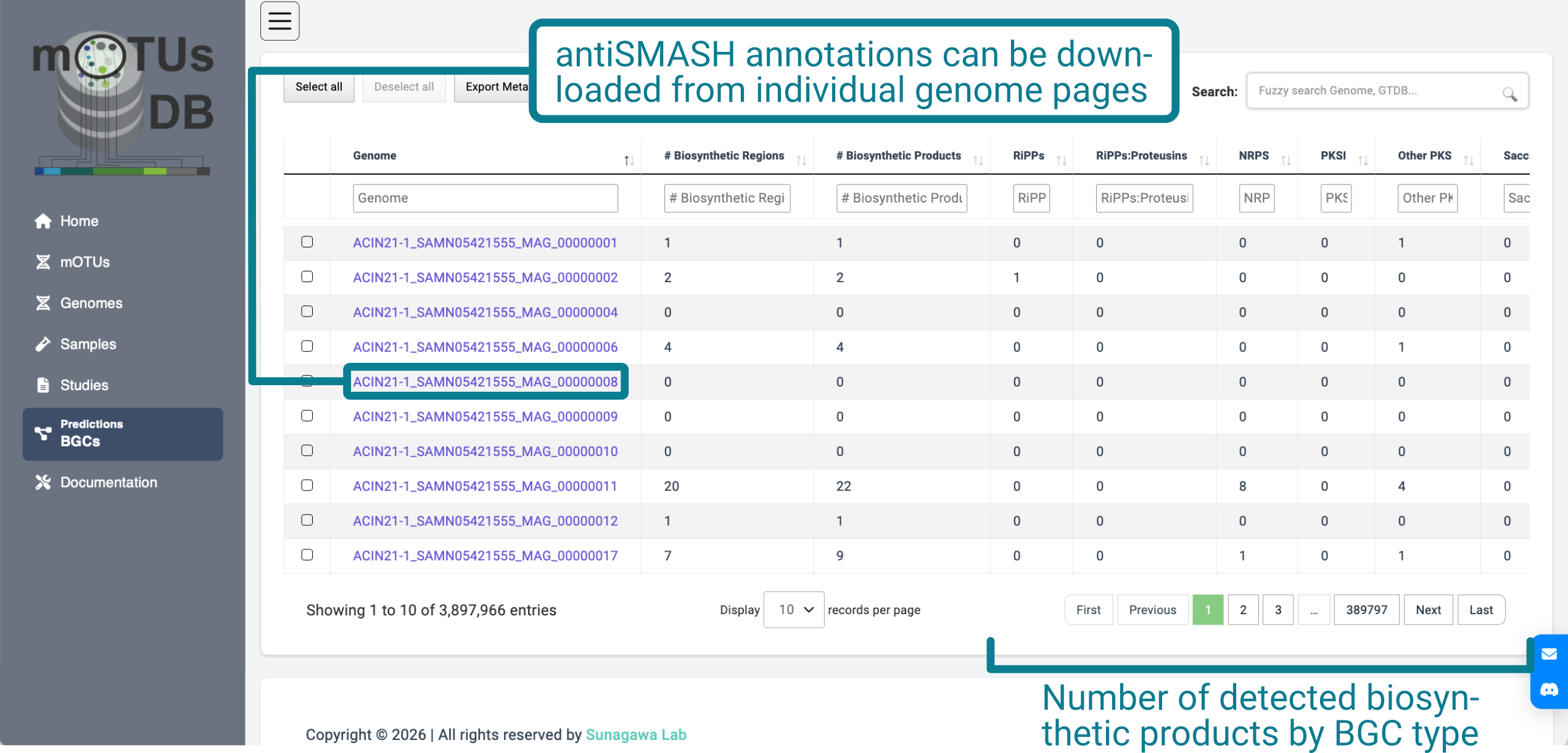
The following table provides an overview of the number of biosynthetic regions and products predicted after running antiSMASH v6.1 on all genomes.
Field Name |
Description |
|---|---|
Genome |
Unique genome identifier representing a metagenome-assembled genome (MAG), single-cell assembled genome (SAG) or isolate. |
# Biosynthetic Regions |
Number of distinct genomic regions predicted to encode biosynthetic gene clusters (BGCs) for secondary metabolites. |
# Biosynthetic Products |
Number of unique chemical compounds or molecular scaffolds predicted to be produced by the identified BGCs. |
RiPPs |
Ribosomally synthesized and post-translationally modified peptides. |
RiPPs:Proteusins |
A subclass of RiPPs characterized by unusually long leader peptides and extensive post-translational modifications. |
NRPS |
Non-ribosomal peptide synthetases, large enzyme complexes that assemble peptides independently of the ribosome. |
PKSI |
Type I polyketide synthases, multifunctional enzymes that produce complex carbon chains through iterative condensation. |
PKS |
General category for polyketide synthases, including all types (I, II, III, and hybrids). |
Saccharides |
Complex sugars, carbohydrates, or glycosylated compounds. |
Terpenes |
Natural products derived from five-carbon isoprene units. |
Other |
Specialized biosynthetic classes not captured by indicated major categories. |
 mOTUs is part of SIB's portfolio of open tools and databases.
 mOTUs is part of the ELIXIR-CH Service Delivery Plan.